

Many of us are “All or Nothing” type of people: finish what you start, do it the right way, discipline is key. Generally it serves us well. Except when it doesn’t. Sometimes rigidity can get in the way of maintaining progress toward a goal, as life may be too challenging for our strict adherence and uncompromising mindset. When we polarize our choices into All or Nothing, we frequently end up with nothing. That’s why I love the phrase “All or Something.” Let me show you why.
Michelle Stegar, a behavioral scientist at the University of Michigan studied the effects of an all or nothing mindset on exercise and establishing long term fitness. In her study, when subjects weren’t able to work out in the exact way they wanted, they often did nothing instead. Dr. Stegar referred to it as the “perfect workout trap.” It can really get in the way of people getting started, waiting for the stars to align to exercise in a specific way. Or it can prevent people from maintaining a fitness routine when they find it too difficult to keep up a specific workout. People often then blame themselves for being too lazy, too unmotivated, or too undisciplined. In reality, the answer is frequently not being more disciplined, but actually being more flexible.
“All or Nothing” mindsets are examples of what psychology defines as a cognitive distortion, specifically referred to as “All or Nothing Thinking” or “Black and White Thinking.” It sorts the world into binary extremes, dichotomous opposites, eliminating shades of gray or more nuanced thinking. It keeps you from seeing life the way it really is: complex, uncertain, and constantly changing. All or Nothing thinking doesn’t allow you to find a middle ground, which can be hard on relationships, self esteem, limit problem solving and decision making, and blocks possible coping skills. Examples include labeling someone as totally unreliable because they canceled plans, thinking you will never get a job because you didn’t get the one you applied for, or if you feel anxious labeling yourself as a weak person.
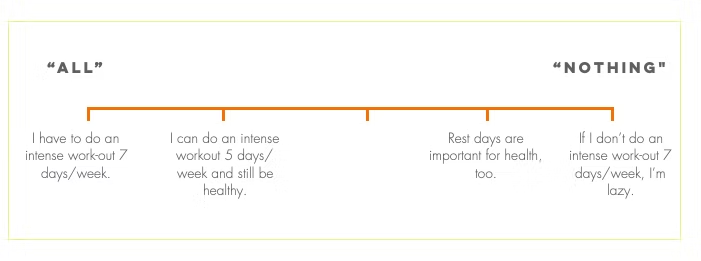
Research on All of Nothing Thinking as a strategy reveals it actually undermines and sabotages long term goals. It causes minor setbacks to trigger total abandonment of efforts. Studies have looked at specific ways this can happen. One is the “What the Hell” Effect, wherein when someone falls short of their ideal, they perceive the mistake as total failure and conclude that all is lost. Rather than recalibrating, the distortion leads to getting rid of their goals entirely. Another potential outcome of All of Nothing Thinking is the devaluation of small progress. The achievement of smaller but beneficial steps toward a goal are seen as not living up to the gold standard and thought of as failure. Studies also show that dichotomous thinking can lead to such high standards that it feels impossible to maintain. This puts a lot of stress and the resulting fear of failure erodes self esteem, leads to burn out, and chronic stress. Research on cognitive errors related to exercise show that strong adherence to black and white rules is directly associated with significantly lower rates of activity and adherence to long term behavioral changes.
Experts suggest addressing this common cognitive trap by redefining success as “beneficial” rather than “optimal.” Even small steps toward a goal can be beneficial and lead to progress. The “All Or Something” approach employs a “bend but don’t break” mentality. It offers adaptability and flexibility that can keep you on track toward the goal while gaining the benefits of doing something rather than nothing along the way. It supports us by giving us permission to develop contingency plans. For example, when trying to stick to an exercise routine, if you can’t get to the gym, have a back up plan of walking around the neighborhood or doing a yoga class at home. Rebranding these adaptations as successes rather than failures helps to keep momentum and a positive attitude..

Combatting the trap of All or Nothing thinking involves shifting your mindset to what you can do rather than what you can’t or didn’t do. Rather than feeling failure or blaming yourself for being lazy or not disciplined enough, you can take pride in your creativity and stick-to-it-ness that keeps the effort sustained. All or Something allows for the real world we live in to be managed and dealt with. Think of your goals as a light you need to keep shining. Why have an on/off only switch when you can have a dimmer dial? One puts you in the dark while the other can be adjusted for just the light you need for the moment.
Love this thought!