GENERATIONAL PATTERN RECOGNITION

My last two posts have been about the effects of child abuse and breaking the cycles of trauma.  Before I move on from the topic of generational patterns, I wanted to broaden the focus to a more general view.  Because not all generational patterns are bad ones! There are, in fact, good patterns that can be passed down and these are worth becoming aware of as well.   A major part of becoming an adult is separating from our family of origin.  Through this process, we can decide what aspects of our family patterns we want to keep, what we want to let go of, and what we may want to transform to fit current times and circumstances.  

Remnants of our ancestry trickle down into our life experience both explicitly (being told and talked about) or implicitly (through observation and deduction).  We learn how the world works as it is passed down through lived experience, one generation to the next.  Our lives are the roadmap for the next generation.  Embedded in our lived experience are conditioned beliefs learned over time that influence our thoughts, behaviors, and perspectives.  These beliefs are formed through childhood interactions with parents, siblings, peers, and caregivers.  They affect a child’s perception of themselves and the world around them.  Praise, criticism, encouragement and punishment all contribute to a person’s understanding of what is valued and what’s unacceptable.  Society and culture also play a role in our conditioned beliefs, often influenced by the types of education, religion, media and institutions we’ve been exposed to by our family’s choices.

Beliefs are reinforced through repetition.  When a child repeatedly hears or experiences something, they’re more likely to internalize it and accept it as truth, even if it’s not based on objective evidence.  Families often have sayings or “mottos” that are so frequently spoken, they’re taken as truths – simply the way things are.  Confirmation bias, attending to information that only confirms a belief, further solidifies these beliefs.  Sayings like “The main thing is you tried” or “boys don‘t cry” are examples of this.  And then there are the unspoken manifestations of conditioned beliefs, reinforced by the reactions and responses, such as smiling at a child for being brave when they express a difference or withdrawing from a child in disappointment.

Children are masters at picking up cues of what is most important to a family.  Even in the face of contradictions.  A parent may say that their child’s education is the most important thing, but then be quick to allow the child to miss assignments or not study in order to play in a baseball game.  It’s so very hard as parents to be aware of all the messages our choices are sending!  Nevertheless, our values and the reinforcement of certain traits or behaviors has a big impact over time and with the repetition of our spoken and unspoken feedback.  

But, as we get older, one of our opportunities in becoming an adult is to become aware of the values and patterns that we have been raised in and decide which are helpful and which are not.  My family had a very strong value of education.  I so appreciate this now, as I had a lot of support and my parents showed great pride in my getting a doctorate.   Luckily, these values felt in alignment with who I was becoming.  Had I been a poor student or not interested in higher education, it would have felt differently.  But along with this came a certain amount of pressure and expectation, a conditioned belief that there was no other choice but to be academically successful.  There are always double edges to everything.  I knew I was loved, but I certainly carried a generational expectation of who I should be.  This has stuck with me as I’ve walked alongside my own children through their ups and downs of education.  The awareness of the impact of our generational pattern helped me to seek a balance of valuing education but not purely academic achievement (I hope my daughters felt that, anyway).

My parents did not intend for me to feel such pressure.  In fact, my father was able to rise out of poverty and took extreme pride in talking his way into an MIT graduate program, coming from a lesser college than many other students.  For him, educational excellence meant  opportunity and he wanted us to have it.  Some beliefs can be empowering and motivating and align with our personal goals and values.  But it’s so important for each of us to critically examine our conditioned beliefs and be open to new information and consider how these beliefs may be influencing our thoughts, actions, and overall well being.  We must ask ourselves, what are the beliefs I was raised with?  What of these beliefs are supportive of my life and what beliefs are limiting or not reflective of who I am or want to be?  Times change and we are very different people than others in our families.  And yet, the bonds of shared history are so very strong and important.  How can we best honor the traditions and values we were raised in and yet alter them to fit our own path in the world?

It’s fun sometimes to sit with my siblings and recall the sayings that my father or mother would throw at us.  Some seem silly and some raise an eyebrow as we think about what impact they had and what it demonstrated about how they were raised and the pressure they were under.  Breaking free from generational patterns does not mean throwing all the patterns out the window, but adapting them to be more mindful of the impact.  We can honor our families by holding on to the intentions that are behind the conditioning.  Most always in a parent’s reaction there is love mixed with fear, pride mixed with concern, and a desire to protect the child mixed with a need to protect themselves.  Developing an understanding of where and how our parents’ patterns came from and how they impacted us will help shape our own freedom in parenting the next generation.  As in, maybe I can support my daughters in being 49ers fans instead of Giants fans?  It’s hard, but I’m trying!!

BREAKING THE CHAIN

“I swore I’d break the cycle,” people often say, “but I’ve become just like him (her).”  As a follow up to my last post regarding the long term effects of early childhood trauma, it made sense to share a post regarding how to heal from it. Survivors of abuse begin to realize the power they assume as they become parents and partners themselves. With this awareness comes the fear and realization that they may not know how to be different, although they desperately want to be.  Adult survivors of abuse often find that breaking the cycle is vastly more complicated than they first thought and involves a lot more than just not doing what was done to them.  Breaking cycles usually involves a deeper exploration of the psychological patterns that lead to abuse.  But, fortunately, doing the work not only reduces the likelihood of repetition, it also offers a chance for healing as we break the chain of learned responding.

We repeat what we know, even if what we know isn’t good.  How often do we hear our own parents’ voices when we talk to ourselves or respond to our children, especially when we’re upset or stressed? These are ingrained internalized responses. They are the patterns we have wired into our brains from early on.  And it’s not only the behavior patterns, but we also inherit and play out the echoes of them in terms of the reactions and feelings and how they are talked about or not talked about.

No one sets out as a parent or partner to inflict pain. Defensive behaviors occur when we don’t know how to regulate and cope with conflicting or uncomfortable feelings. Healing involves turning toward difficult emotions that weren’t safe to express, being able to label them and feel them. Once we can sit in the discomfort of them, we begin to gain control over them. In therapy, we work from the outside in, so to speak.  First we look at the behavior that a person wants to change.  It can be yelling, eating, drinking, lashing out, criticizing themselves or someone else.  What triggered the behavior? What was happening right before we acted?  What feelings were there?  Usually people can identify some sort of overwhelm. But if they can sit with the experience, they can dig a little deeper into anxiety, shame, or guilt. If they can still sit with this a little deeper, underneath the anxiety or shame is a feeling that was unacceptable in the family. This may be anger, sadness, or a need that was responded to in the past as threatening.  The chain becomes revealed – the defensive behavior was in response to shame/anxiety, the anxiety/shame was in response to potentially feeling an unacceptable feeling that could not be voiced.

Breaking the cycle involves slowing down and allowing yourself to feel something that at first may be scary or uncomfortable or even hard to identify.  For example, in many families, telling the truth about someone’s drinking was unacceptable. To fit in the family norms, a child learns to shut down in response to the drinking behavior and stay quiet, convincing themselves that the craziness is normal.  Maybe even they are the crazy one for being upset about it.  Now as an adult, when things seem out of order, they’ve learned not to speak up.  Instead they stuff their feelings of concern and disapproval.  When the feelings come up, they feel guilty and maybe even withdraw rather than confront someone.  Because they shut down, they never speak up and address the problem in the relationship directly, and the effects cause unhealthy patterns to persist.  Cycle breaking would involve being able to give permission to become aware of the feeling that something is wrong and that it is ok to address it.  This may involve using feelings of anger or discomfort as messengers that we need to listen to rather than shameful acts of disrespect that need to be hidden

Identifying, labeling, and interpreting our own feelings are a key pathway to emotional regulation and communication. By unblocking emotions that have been off limits, we can learn to understand them and what they’re telling us. Once we understand them, we can choose to act in a variety of ways, based on rational thoughts rather than fear and shame.  We can use these emotions to direct us toward actions that empower us and bring us closer to people, rather than destructive and repetitive behavior chains.

When people tell me, “I was doing ok, and then, I don’t know what happened, I just snapped,” it’s true. They didn’t conciously experience the emotional chain that led to the behavior.  It takes time and real effort to turn inward and learn what’s there. Breaking a cycle is not a one time event.  It takes small steps to do things differently over and over until it becomes the new pattern.  Breaking a cycle involves unhooking each link of a chain to free it up from its predecessor. This gives us the opportunity to create a new path with every freed up disconnection.  Now who says being unhinged is such a bad thing?

WHO WOULD I BE IF…

I recently listened to a very moving podcast featuring a New York Times reporter, Robert Draper, being interviewed about his therapeutic experience with a psychedelic drug.  Not usually so personally transparent, Mr. Draper reveals poignantly about his history of childhood trauma and the pain he felt throughout his life.  Desperate for relief, he travels to a treatment Center in Mexico that offers supervised medically assisted psychedelic trauma treatment. Mr. Draper describes intense experiences of hallucinations opening a pathway for moving beyond the burdens he carried.  One of the incidents he describes as vividly intense deeply resonated  with me. It was the felt experience of having strong personal confidence and being in harmony with himself, revealing to him the man he could have been and might one day be.  In my work with many people who have been victims of childhood trauma, this is a frequent question:  “Who might I have been if…”

With any traumatic experience, a survivor must come to terms with what was lost and what was changed as a result of the trauma.  It’s a long journey of healing and a transformation of one’s own identity.  People often describe their life in two phases:  life before the trauma and life after the trauma.  And for some who are fortunate, they also consider the gifts in this transformation.  I’ve written in the past about “traumatic growth,” a positive psychological phenomenon wherein survivors describe enhanced personal strength, deeper relationships, and a greater appreciation for life as a result of the challenge. These adult traumas (cancer, sudden loss of a loved one, losing a house in a fire) happen to us as mostly formed people.  We know who we were before and how we are changed after.  But the nature of childhood trauma is drastically different.  It shapes our lives in a continual way from an early age.  We are not a person being affected by trauma, but are being shaped and formed through the experience of it.  A child in an abusive home is developing their identity in reaction to and in coping with violence and/or neglect.

In working with so many people affected by childhood trauma, there comes a point in therapy in  which they begin to separate from the question of what is wrong with them to evaluating and having compassion for the effects of what happened to them.  There’s a deep relief in reassigning their “defectiveness” as necessary strategies they used to cope.  For example, what in present day relating is seen as hypervigilance and co-dependent behavior was for the child a way of predicting when a parent was drunk and needed to be taken care of in order for them to be safe.  People begin to see the reasons for their maladaptive behaviors as strategies developed for surviving in a chaotic, maladaptive, and unsafe childhood home.  With this understanding, what was carried as shame can be transformed into compassion and even pride.  What was done in desperation as a child with no control over major things in their life can now, as an adult, be appreciated, changed and chosen.  But often in parallel with this understanding of how they were shaped by their trauma comes a deep and profound sense of loss. There is a rich grieving process for the childhood they never had and the person they might have been had they not been raised under such stress.  There is a longing and a reckoning with “Who would I be if …”  The list is poignant:  Who would I be if I had felt safe?  Who would I be if I was loved and cared for?  Who would I be if someone had protected me?  

The healing process of overcoming a disconnection to oneself and exploring the differences between what is truly you and what was a defense mechanism for survival is thorny and complicated.  Our brains have literally been wired around the experience of our abuse and coping.  This is why psychedelic drug treatment appears to be so hopeful.  The effect of the drug is to access neuroplasticity in which we can rewire the neural networks that have been entrenched with old patterns and self images.  As Richard Draper explains, the result of his hallucinatory state is the sudden emergence of experiencing himself differently.  He is exposed to the possibility of being and feeling differently.

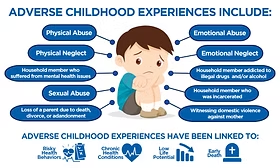
The research on childhood toxic stress and its effect on long term health is a promising and long overdue body of knowledge. The Adverse Childhood Events (ACES) screenings are helpful in identifying children who might be at risk to offer early intervention.  It’s also helpful for adults to understand how the things that happened to them early in life may be explanatory for current physical and mental health challenges.  Untangling the connection of love and violence is hard to do when they are merged together in an abusive home. When the person who says they love you also hurts you, humiliates you, and neglects your needs, it’s hard to internalize a healthy sense of identity and a positive model for future relationships.

The benefit to this societal awareness is also empowering as it has revealed the potential for all of us to make a difference.  Research shows a strong protective effect of having someone who they consider caring in the life of an at risk individual.  A strong bond with at least one adult is a significant buffer against negative mental health outcomes and behavioral problems. We can be that person if we pay attention and make the effort.  Being a grandparent, uncle, aunt, cousin, mentor, neighbor or teacher gives us access to offering a relationship that can fill a gap and provide a touchstone of safety for someone who feels alone and vulnerable.  A dose of a loving relationship now may prevent the need for a dose of psychedelics in the future.  Our love and stability is a powerful treatment option we all can deliver.